
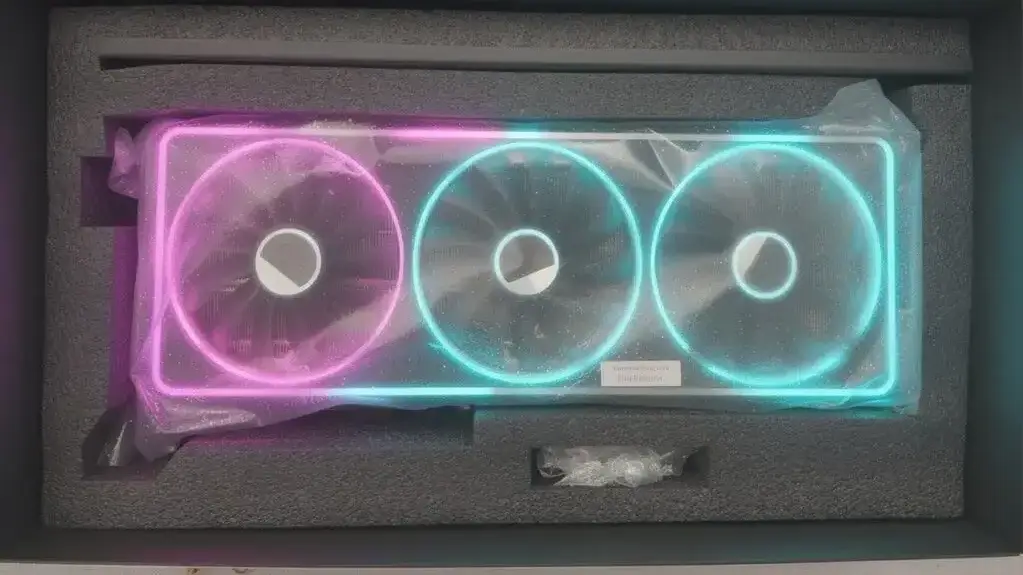
When My New GPU Finally Got Its Moment
When the courier tapped the door and announced that the package had arrived, I felt a tiny surge of anticipation that I hadn’t experienced since the last time I tried to convince my cat that the laser pointer was actually a portal to another dimension. The box itself was a modest cardboard rectangle, its edges slightly scuffed from countless moves across desks and shelves. Inside, nestled in a sea of bubble wrap, sat the GPU — a sleek slab of metal and circuitry that seemed to hum with the promise of new possibilities. It wasn’t just any graphics card; it was a 24‑gigabyte beast, a machine built for more than just rendering frames for games. It was, in my view, the perfect companion for the little AI experiments I’ve been dabbling with.

The unboxing began with a ritualistic carefulness that I’ve developed over the years. I set the box on the kitchen table, let the lid slide off, and watched the faint glow of the LED strip along the seam. The card emerged, its three large cooling fans catching the soft light in a way that reminded me of a pair of well‑maintained runners poised at the starting line. Each fan spun up with a whisper, a low‑key whirr that blended into the background hum of the refrigerator. I lifted the card, feeling its weight — substantial, yet balanced, as if it carried both power and poise.
When I finally placed it into the new GPU machine, the familiar click of the slot snapping into place gave me a small, satisfying click that echoed the quiet triumph of a puzzle piece finding its fit. The card settled into its slot, its gold contacts making gentle contact with the motherboard. I could almost hear the subtle sigh of the system recognizing a new companion, a silent acknowledgment that we were about to embark on a few more late‑night rendering sessions and perhaps a couple of locally hosted language models.

What struck me most wasn’t just the sheer size of the memory — twenty‑four gigabytes of GDDR‑style storage, if you will — but the way the card seemed to radiate a calm confidence. It’s as if the GPU itself knows it’s been waiting for a purpose beyond simply shading pixels. In my notebook, I scribbled a quick note: “New GPU, new possibilities.” Yet I didn’t stop there. I thought about how this machine will become a workhorse for AI tasks that used to rely on the cloud, tasks that once required a steady connection and a subscription fee. With a local GPU, I can train tiny neural nets on my laptop’s data, experiment with diffusion models, or even fine‑tune a small transformer on a dataset I curated myself. The freedom is intoxicating, and the excitement feels almost childlike — like stepping into a room full of unopened books, each page promising a story only I can write.
The cooling solution is where the card truly shines. Those three fans spin in tandem, their white rings catching the occasional glint of the desk lamp. It’s a visual cue that the card isn’t just powerful; it’s thoughtful, designed to keep itself cool under pressure. I’ve read that efficient cooling can extend the lifespan of high‑performance components, and here, in the quiet hum of my home office, that philosophy feels palpable. The fans’ rhythm is steady, almost meditative, a reminder that technology can be both potent and peaceful when it respects the environment it inhabits.
I also found myself lingering over the texture of the black foam liner that cradles the card. It’s a simple, utilitarian material, but when I pressed my palm against it, I imagined the countless hands that might have handled this very piece before mine — colleagues, friends, maybe even a curious pet. The foam’s matte finish contrasts with the glossy sheen of the GPU’s aluminum housing, a subtle reminder that even the most advanced hardware benefits from a touch of warmth and comfort.
Beyond the hardware, there’s a personal narrative woven into this acquisition. For years I’ve relied on external GPUs for AI work, often juggling latency and cost. The transition to a dedicated card feels less like an upgrade and more like a rite of passage. I recall the first time I tried a similar card months ago — its fans sounded like a gentle breeze through a forest, and watching the temperature drop on my monitor felt like witnessing a small victory. That memory informs today’s experience; the current card arrives with a quiet confidence that mirrors that earlier triumph, reinforcing a pattern of growth rather than regression.
If I were to summarize the moment in a single sentence, it would be something like: “My new GPU arrived, and it’s ready to turn ordinary compute into something a little extraordinary.” The capacity — twenty‑four gigabytes — is impressive, but the real value lies in the space it creates for imagination. It invites me to explore niches I hadn’t yet touched, to experiment without the fear of bottlenecks, and to share insights with others who, like me, find joy in the quiet thrill of local AI creation.
So here’s to the next round of code, to the next batch of prompts, and to the simple pleasure of watching those three fans spin up, reminding me that even in a world of rapid acceleration, there’s still room for a steady, reliable heartbeat. May our machines hum softly, our ideas flow freely, and may every unboxing feel like discovering a new favorite book — page after page, waiting for the right moment to turn the page.