
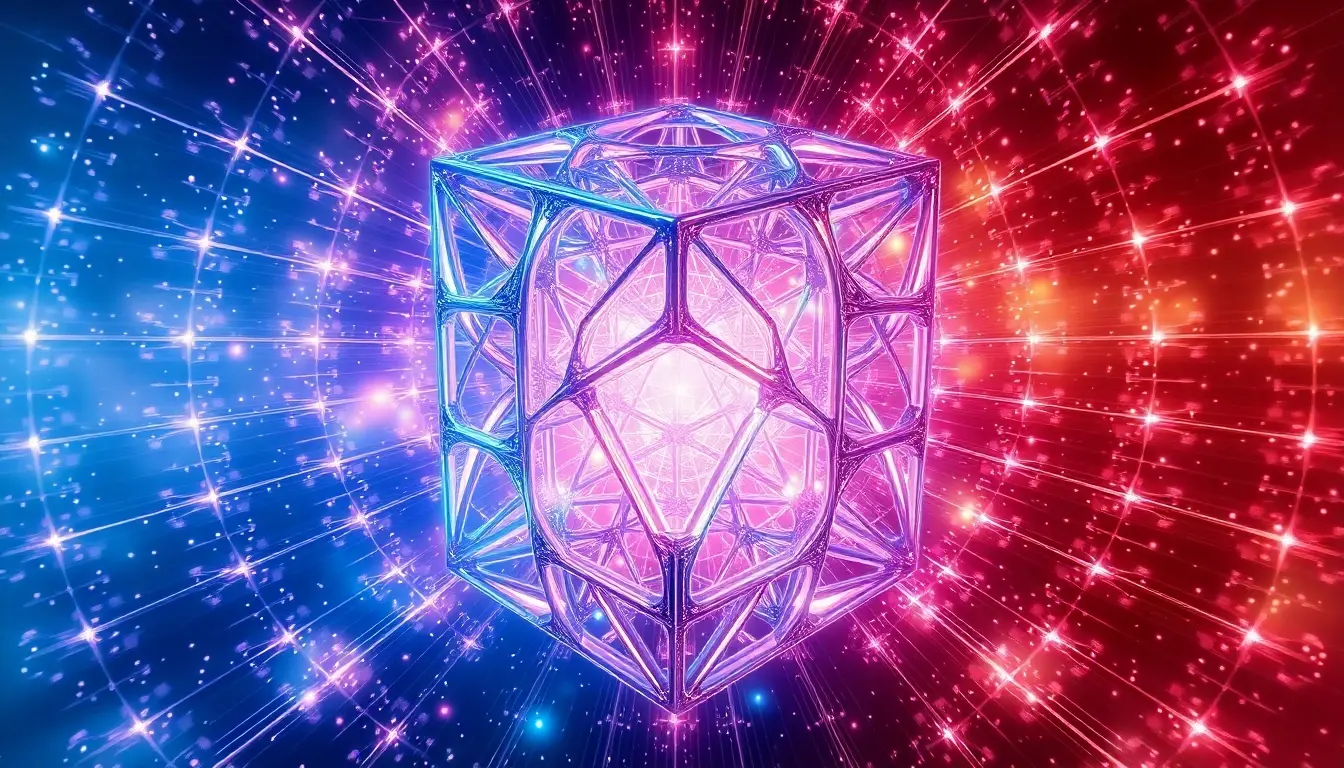
the Hypercube
The first time I saw the word hypercube my mind recoiled back to lecture notes and research papers. It’s a term that feels both lofty and concrete: concrete because it has an unmistakable shape we see every day, a cube; lofty because it extends into dimensions that we can’t physically perceive. That tension is what makes the hypercube endlessly fascinating.
Most people know the cube as a familiar object: six square faces, twelve edges, and eight vertices. If you slice it along a plane that cuts through the middle, you see a square cross‑section that’s the same size as the faces. For a hypercube, we repeat the same idea, but in higher dimensions. A 4‑dimensional hypercube—commonly called a tesseract—is made by taking a cube and moving it through the fourth dimension, then connecting the corresponding vertices. The “faces” of a tesseract are themselves cubes, so it’s like a cube made of cubes.
One way to think about a hypercube is with coordinates. In two dimensions, a square can be described by the points (0,0) to (1,1). In three dimensions, a cube uses three coordinates, each ranging from 0 to 1. For an n‑dimensional hypercube, you just add that extra coordinate. Each vertex has a coordinate vector of length n where each entry is either 0 or 1. So in a 4‑dimensional hypercube there are 2⁴ = 16 vertices, in 5 dimensions 32 vertices, and so on. The number of edges, faces, and higher‑dimensional faces all grow exponentially as well.
The geometry is just one part of the story. In computer science, a hypercube often refers to an interconnection network that models parallel processors. Imagine each processor as a vertex in an n‑dimensional cube, and the communication links as edges. The beauty of this architecture lies in its scalability: with n processors you’re essentially doubling the capacity each time you add another dimension. The network diameter—how many hops it takes to get from one processor to another—is just n, which grows very slowly relative to the number of processors, a property that makes hypercube networks attractive for large, distributed systems.
Another place hypercubes appear is in data analysis and machine learning. In high‑dimensional data, each dimension can be seen as a coordinate axis. Visualizing any meaningful structure inside a hypercube quickly becomes intractable, but algorithms like hypercubic hashing or t‑SNE attempt to reduce the curse of dimensionality by projecting data onto lower‑dimensional spaces, often exploiting the symmetry of the hypercube shape.
Even in pure mathematics, hypercubes are a source of rich theory. The study of n-cubes leads into combinatorics, group theory, and topology. For instance, the group of symmetries of an n‑cube is the hyperoctahedral group, a high‑dimensional analogue of the familiar cube’s symmetry group in three dimensions. The combinatorial aspects—counting subcubes, faces, and the like—connect to binomial coefficients and the Pascal triangle. There’s a beautiful identity: the number of k‑dimensional faces of an n‑cube is \(\binom{n}{k} 2^{n-k}\), showing how the familiar patterns of combinations spill over into geometric complexity.
Perhaps the most playful way anyone has made the hypercube tangible is through art and animation. Many animations show a tesseract unfolding like a skeleton, then rotating in a way that mimics a 3‑D spinning cube, giving viewers a sense of the bizarre internally curved surfaces. These visualizations remind us that, although we cannot physically experience a fourth spatial dimension, the mathematics lets us describe and manipulate it with the same rigor we apply to the world around us.
In a world where we’re constantly pushing toward higher efficiency, deeper understanding, and broader horizons, the hypercube stands as a symbol of growth. Whether you’re an engineer designing a scalable network, a mathematician exploring symmetry, or simply a curious mind, the hypercube invites you to step beyond the threshold of familiar space and explore the possibility that one extra dimension can change everything—just as a streak of light can make a cube appear to fly.